

About Islam

English Pamphlet Translated
Filename: About Islam
Locale: Unknown
About Islam
PDF Version
Islam is a natural and complete way of life. It encourages one to give due attention to their relationship with their Creator (God). It teaches that people find true lasting happiness and peace through being close to God, following His guidance and performing good deeds.

Muslims constitute approximately one fifth of the world’s population, making Islam one of the largest religions. Belief in and worship of the One True God is the purpose of life and cornerstone of Islam.

The Arabic word "Islam" literally means "submission" to the One True God alone. One who voluntarily surrenders their will to God is called a Muslim, who can be from any racial or ethnic background. A distinguishing feature of Islam, unlike many other religions, is that it is not named after a person or tribe.

The 6 Aspects (Articles) of Belief
1. Belief in Allah
"Allah" is the unique Arabic name of The One True God. Allah has no rivals, partners, equals, children or parents. He is not like His creation, as nothing shares His divine essence and perfect attributes. Some of His names and attributes include: The Creator, The Most Merciful, The Most High, The All-Powerful, The Most Just, The All-Wise, The Sustainer and The All-Knowing.

He is the Creator and Sustainer of all, the One who has granted us countless blessings, such as our faculties of hearing, seeing and thinking, as well as the ability to walk, talk and be productive. As such, we should acknowledge, thank and worship Him alone by following His guidance.

It is rational to conclude that such a complex and balanced universe is not possible by any other than a powerful and intelligent being. It is therefore illogical to believe that the universe created itself, or was the result of random or coincidental events.
2. Belief in the Angels
Angels are made from light, have allocated tasks and never disobey their Creator. Details about a few have been revealed, such as Gabriel, who delivers God’s message to the Prophets, and the Angel of Death, who takes the souls of people.
3. Belief in the Revealed Books
Allah sent divine revelation to His Messengers as a guidance and mercy to mankind. These include the Torah and Gospel as originally revealed to Moses and Jesus respectively, and the Quran as revealed to Muhammad (peace be upon them all).

The Quran is the literal word of God and the final revelation to all of mankind. There are many clear signs and miracles that it is from God, examples of which include:
Contains a simple, pure and universal message which appeals to Man’s inherent beliefs about Almighty God.
Contains a unique style of language that is universally known as the pinnacle of Arabic eloquence and linguistic beauty – yet the Quran was revealed to Prophet Muhammad (peace be upon him) who was known, historically, to be illiterate.
Contains many scientific facts which have only been discovered recently despite being revealed over 1400 years ago.
Free from any errors or contradictions.
Preserved, word-for-word, since it was revealed in its original Arabic language, unlike other scriptures which have been distorted, changed or lost.
The most rational explanation for the many unique and miraculous aspects of the Quran is that it can only be from God. Together with the authentic sayings and actions of Prophet Muhammad (peace be upon him), it is the primary source of Islamic knowledge.
4. Belief in the Prophets
Muslims believe that thousands of Prophets were sent by Allah, at least one to every nation, to convey God’s revelation. These Prophets include Adam, Noah, Abraham, David, Joseph, Moses, Jesus and Muhammad (peace be upon them all). Their mission was to return people to the worship of the One True God, to serve as practical examples of how to obey God, and to guide people to the path of salvation. Prophets do not share in any part of God’s divinity, and any type of prayer or worship towards the Prophets, or to God through them, is strictly forbidden and considered a violation of God’s right to be worshipped alone.

– Prophet Jesus

Muslims believe that Jesus is an honourable prophet of God, born miraculously through his virgin mother Mary. He performed many miracles with the permission of God, such as healing the sick, curing the blind and speaking as a newborn defending his mother from accusations. Although Muslims respect and love Jesus, they do not worship him. He is not considered the son of God, nor part of a trinity, nor does he share in any of God’s perfect attributes. God says:
"It is not befitting for Allah to take a son; exalted is He! When he decrees an affair, He only says, ‘Be’ and it is."
Quran 19:35

– Prophet Muhammad

Muhammad (peace be upon him) was the final Prophet sent to all of mankind. He came with the Quran to demonstrate how its teachings should be applied, and was a perfect example of an honest, just, merciful, compassionate, truthful and brave human being. As with Jesus, Muslims do not worship Muhammad.
5. Belief in the Day of Judgement
The Day of Judgment is the inevitable event when each one of us will stand before our Creator and be questioned about our good and bad deeds. Every one of our actions will be accounted for, regardless of size.

On this momentous Day, Allah, the All-Just, will settle all matters fairly and no person will be wronged. Everyone’s rights will be returned. All will be treated justly, by either the reward of Paradise, or the punishment of the Hellfire. Without a Day of Judgement, life would be grossly unfair, as not everyone receives justice in this world.
6. Belief in Divine Destiny
Allah knows everything from the past, the present, and anything that will occur in the future. He has power over all things – nothing occurs without His knowledge and permission.

Every person has been given the free will to choose between right and wrong, and will be held to account accordingly

Free will does not contradict the fact that events can only occur with God’s knowledge and permission. Nor does it mean that God’s power over everything prevents or restricts people’s free will. God’s knowledge of people’s decisions does not mean that they are being forced to make such decisions, and God is not necessarily pleased with everything that He allows to occur.
The 5 Pillars of Worship
The foundation of a Muslim’s life.
1. The Declaration of Faith
The declaration of faith is bearing witness that there is no God worthy of worship except Allah, and Muhammad is His Messenger. It must be based on a sincere and firm belief in the heart, followed by action. With this declaration, a person rejects all false deities, asserts that Allah is the only One worthy of worship, and accepts His final Messenger, hence becoming a Muslim.
2. The Five Daily Prayers
Prayer establishes a personal and spiritual connection between the Muslim and their Creator, and is a constant and practical reminder of a person’s duty to obey God. The five prayers are prescribed once each at dawn, noon, mid-afternoon, sunset and nightfall. Each prayer can take a few minutes to perform, consisting of recitation of the Quran, supplications, praising Allah, and various movements. In preparation for prayer, Muslims wash certain parts of their body, such as the face and hands, to ensure spiritual and physical purity.
3. The Annual Charity
The annual charity is an obligation on every Muslim who meets certain criteria (e.g. has wealth above a certain threshold). A mere 2.5% of one’s annual wealth is donated to those who are eligible, such as the poor, the needy or those in debt. It purifies one’s wealth and carries many benefits for both the giver and the receiver. One benefit is it reduces the gap between the rich and poor, ensuring everyone has their basic needs met.
4. The Annual Fasting
Every year during the month of Ramadan, Muslims fast from dawn until sunset, abstaining from food, drink and sexual relations. It serves as a spiritual purification, nurtures patience and self-restraint, and provides many health benefits.
5. The Pilgrimage
Pilgrimage to the holy city of Makkah, in Saudi Arabia, must be performed once in a person’s life, if they are physically and financially able. It occurs annually in the 12th month of the Islamic calendar, unifying people of every colour, race, status and age, as they join in worship of the One True God. All pilgrims wear simple and similar clothing, which strip away distinctions of class and culture, so that all stand equal before God. This great journey consists of many components, including sacrifices, travelling and praying at various sites. Such an experience is life altering and humbles a person, making them more patient and thankful.
The Concept of Worship
Any action that Allah is pleased with.

Islam’s concept of worship is not restricted to only the five pillars. Worship is an all-inclusive term for any actions that are pleasing to Allah. Everyday activities can become acts of worship by purifying one’s intention and ensuring one’s actions are in line with God’s guidelines. Examples include smiling, being good to one’s neighbours, supporting one’s family, being honest, and even removing rubbish from the road.

It should be noted that Allah is not in need of anyone’s worship, rather, we are in need of Him and our worship is for our benefit.
Conclusion
The above-mentioned aspects of faith and acts of worship make up the essence of Islam. When practised, Islam fulfils the spiritual, physical, psychological and social needs of all people, and is a practical and rational way of life. Furthermore, it is the only way of life which is accepted by God Almighty, and the only path that leads to everlasting Paradise.
"Whoever does righteousness, whether male or female, while he is a believer – We will surely cause him to live a good life, and We will surely give them their reward [in the Hereafter] according to the best of what they used to do."
Quran 16:97
ملخص حقوق انجليزي

Summary of rights called for by Fitrah

ملخص حُقوق دعت إليها الفطرة وقرَّرتها الشريعة باللغة العربية لابن عثيمين رحمه الله
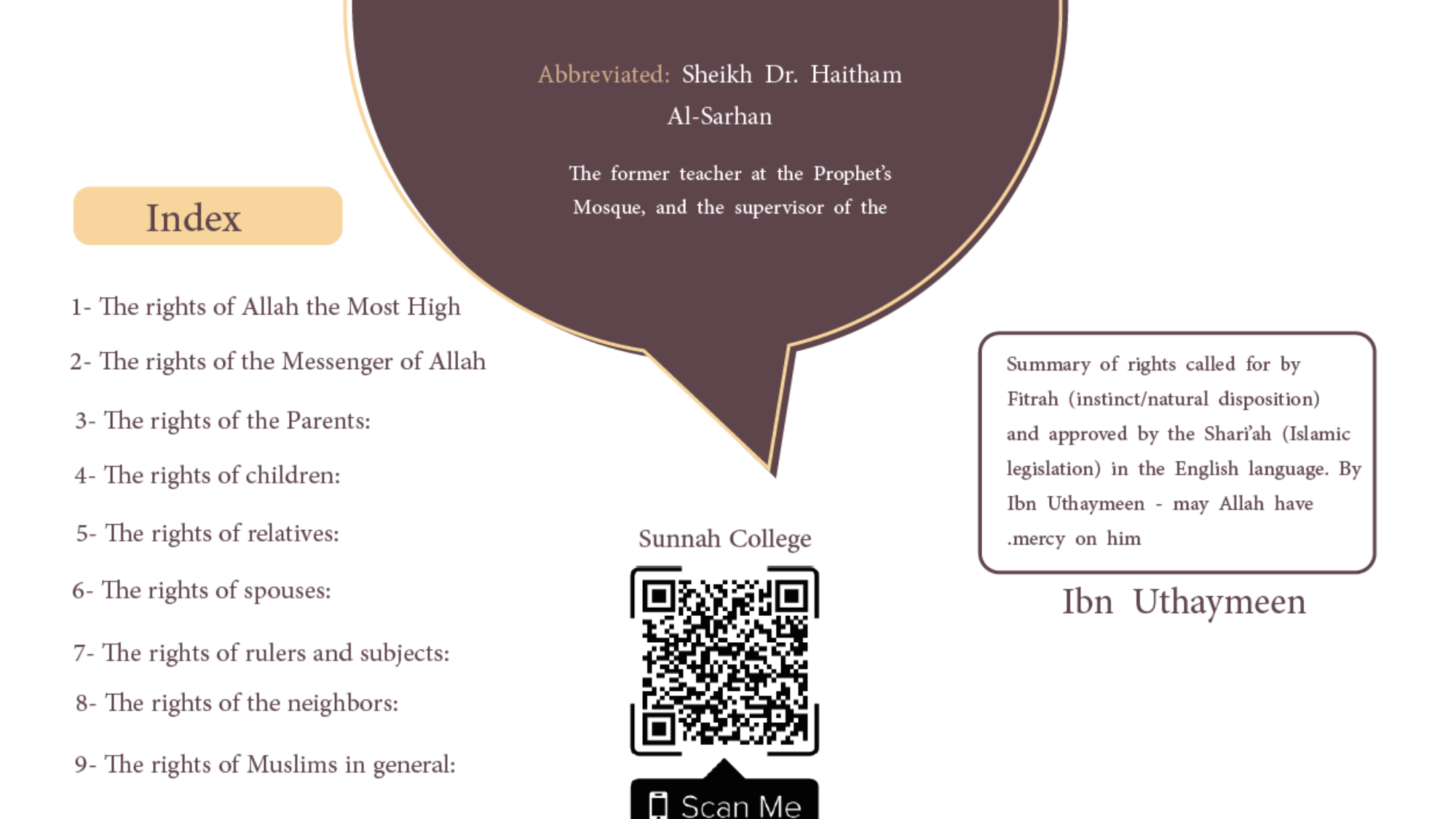
Summary of rights called for by Fitrah (instinct/natural disposition) and approved by the Shari’ah (Islamic legislation) in the English language. By Ibn Uthaymeen – may Allah have mercy on him.

1ـ حقُّ الله تعالى
أن تعبده وحده لا شريك له، وتكون عبدًا متذللا خاضعا له، ممتثلا لأمره، مجتنباً لنهيه، مصدِّقا بخبره، عقيدة مثلى، وإيمانٌ بالحق، وعمل صالح مثمر، عقيدة قوامها: المحبة والتعظيم، وثمرتها: الإخلاص والمثابرة.

1- The rights of Allah the Most High:

To worship Him Alone without any partners, and that you be a humble, submissive worshipper to Him, obeying His commands, avoiding His prohibitions, and believing in what He informed us about. It is a perfect Aqeedah (Islamic creed), belief in the truth, and righteous fruitful deeds. It’s an Aqeedah based on love and glorification; its fruit is sincerity and perseverance.

2ـ حقّ رسول اللّه ﷺ
توقيره، واحترامه، وتعظيمه؛ التَّعظيم اللائق به، من غير غلوٍّ ولا تقصير.
وتصديقه فيما أخبر به من الأمور الماضية والمستقبَلة، وامتثال ما به أمر، واجتناب ما عنه نهى وزجر، والإيمان بأن هديه أكمل الهدي، والدفاع عن شريعته وهديه.

2- The rights of the Messenger of Allah ﷺ:

The right of the Messenger of Allah ﷺ is to be honored, respected, and glorified appropriately without exaggeration nor deficiency.
Also believing him in what he has informed us about past and future events, doing what he commanded us to do, avoiding what he prohibited, believing that his guidance is the perfect guidance, and defending his Sharee’ah (Islamic legislation) and guidance.

3ـ حقوق الوالدين
تبرهما، وذلك بالإحسان إليهما قولًا وفعلا بالمال والبدن، وتمتثل أمرهما في غير معصية الله، وفي غير ما فيه ضرر عليك.

3- The rights of the Parents:

Be righteous to them by treating them with goodness in word and deed, with money and the body, and obeying their commands in that which is not disobedience to Allah and doesn’t cause any harm to you.

4ـ حقُّ الأولاد
1ـ التربية؛ وهي تنمية الدين والأخلاق في نفوسهم حتى يكونوا على جانب كبير من ذلك
2ـ أن ينفق عليهم بالمعروف من غير إسراف ولا تقصير
3ـ ألا يفضل أحدا منهم على أحد في العطايا والهبات

4- The rights of children:

1- Upbringing: it is the development of religion and morals in their hearts to a high standard.
2- To spend on them in a reasonable manner, without extravagance nor negligence.
3- Not to give preference to any of them over the other in spending and gifts.

5ـ حقوق الأقارب
أن يصل قريبه بالمعروف؛ ببذل الجاه، والنفع البدني، والنفع المالي بحسب ما تتطلبه قوة القرابة والحاجة.

5- The rights of relatives:

To uphold ties of kinship with kindness by using your social position, physical efforts to benefit them, and financially depending on how close and needy they are.

6ـ حقّ الزوجين
أَن يعاشر كل منهما الآخر بالمعروف وأن يبذل الحق الواجب له بكل سماحة وسهولة من غير تكرّه لبذله ولا مماطلة.
من حقوق الزوجة على زوجها: أن يقوم بواجب نفقتها من الطعام والشراب والكسوة والمسكن وتوابع ذلك، والعدل ببن الزوجات.
من حقوق الزوج على زوجته: أن تطيعه في غير معصية اللّه، وأن تحفظه في سره وماله، وألا تعمل عملا يضيع عليه كمال الاستمتاع.

6- The rights of spouses:

To live with each other in a kind manner and give the right that is due to him with tolerance and ease without any compulsion or procrastination in fulfilling each other’s rights.

Among the rights of the wife over her husband: that he fulfils the duty of spending on her in terms of food, drink, clothing, housing and so on, and that he treats all his wives equally.

Among the husband’s rights over his wife: that she obeys him in that which is not disobedience of Allah, protects his secrets and wealth, and does not do something that would spoil his complete enjoyment.

7ـ حقوق الولاة والرعية
حقوق الرعية على الولاة: أن يقوموا بالأمانة التي حملهم الله إياها وألزمهم القيام بها من النصح للرعية والسير بها على النهج القويم الكفيل بمصالح الدنيا والآخرة، وذلك باتباع سبيل المؤمنين.
حقوق الولاة على الرعية فهي: النصح لهم فيما يتولاه الإنسان من أمورهم، وتذكيرهم إذا غفلوا، والدعاء لهم إذا مالوا عن الحق، وامتثال أمرهم في غير معصية الله، ومساعدتهم.

7- The rights of rulers and subjects:

The rights of the subjects on the rulers: to carry out the trust that Allah has given them and obligated upon them, such as advising their subjects and taking them on the right path that guarantees their benefit in this world and the hereafter, and that is by following the path of the believers.

The rights of rulers over the subjects are: advising them in what a person is responsible for in their affairs, reminding them if they become negligent, making Du’a’ (praying) for them if they deviate from the truth, obeying their commands in that which is not disobedience to Allah, and helping them.

8ـ حق الجيران
الجار: هو القريب منك في المنزل، يحسن إليه بما استطاع من المال والجاه والنفع، ويكفّ عنه الأذى القولي والفعلي.
1ـ إن كان قريبا منك في النسب وهو مسلم فله ثلاثة حقوق: حق الجوار، وحق القرابة، وحق الإسلام.
2ـ إن كان مسلما وليس بقريب في النسب فله حقان: حق الجوار، وحق الإسلام
3ـ وكذلك إن كان قريبا وليس مسلما فله حقان: حق الجوار، وحق القرابة
4ـ إن كان بعيدا غير مسلم فله حق واحد: حق الجوار

8- The rights of the neighbors:

A neighbor is someone who lives close to you. You should be good to him with what you can using money, social position, and help. You should also refrain from any verbal or physical harm.

1- If he is a relative and a Muslim, he has three rights: the right of the neighbor, the right of kinship, and the right of Islam.
2- If he is a Muslim but not a relative, he has two rights: the right of the neighbor and the right of Islam.
3- Likewise, if he is a relative and is not a Muslim, he has two rights: the right of the neighbor and the right of kinship.
4- If he is not related and is a non-Muslim, he has only one right: the right of the neighbor.

9ـ حقوق المسلمين عموما
منها السلام، وإذا دعاك فأجبه، وإذا استنصحك فانصحه، وإذا عطس فحمد الله فشمّته، وإذا مرض فعده، وإذا مات فاتبعه، وكف الأذى عنه.
حقوق المسلم على المسلم كثيرة، ويمكن أن يكون المعنى الجامع لها هو قوله ﷺ «المسلم أخو المسلم» فإنه متى قام بمقتضى هذه الأخوة اجتهد أن يتحرى له الخير كله، وأن يجتنب كل ما يضره.

9- The rights of Muslims in general:

From them is: giving Salam; if he invites you, accept the invitation; if he asks you for advice, advise him; if he sneezes and says ‘Alhamdulillah’, say ‘Yarhamukallah’; if he is sick, visit him; if he dies, follow his funeral; avoid causing him any harm.

The rights of a Muslim over a Muslim are many, and they can be summarized in meaning by the Prophet’s ﷺ saying: “A Muslim is a brother to a Muslim.”  Fulfilling the requirements of this brotherhood will make a person strive to seek all goodness for his Muslim brother and avoid anything that harms him.

10ـ حق غير المسلمين
يجب على ولي أمر المسلمين أن يحكم فيهم بحكم الإسلام في النفس والمال والعرض، وأن يقيم الحدود عليهم فيما يعتقدون تحريمه، ويجب عليه حمايتهم وكف الأذى عنهم.
ويجب أن يتميزوا عن المسلمين في اللباس، وألا يظهروا شيئا منكرا في الإسلام، أو شيئا من شعائر دينهم؛ كالناقوس، والصليب.
10-The rights of non-Muslims:

A Muslim ruler must rule over them with the law of Islam in their lives, wealth, and honor, set limits on them according to what is Haram (forbidden), and he must protect them and not harm them.

The disbelievers must be distinguished from Muslims in dress code. Also, they must not show (i.e., publicly) anything objectionable in Islam or any of the rituals of their religion, like the bell or the cross.

هيا بنا نتعلم نيبالي

आउनुहोस् हामी सिकौं

आउनुहोस् सिकौं: यो डाक्टर हैसम सरहानद्वारा लिखित र नेपाली भाषामा अनुवादित एउटा पुस्तक हो जसले मुस्लिम बालबालिकालाई धर्म,आचरण र इस्लामिक नैतिकताका सिद्धान्तहरू एउटा रोचक र रमाईलो विधि मार्फत सिकाउने उद्देश्य राखेको छ, जसलाई जानकारीको विश्वसनीयता र धार्मिक नियमहरूको पालनाको संयोजन र बच्चाको खेल,मनोरञ्जन र कौतुहलतालाई ध्यानमा राख्दै तयार गरिएको छ।

هيا بنا نتعلم: كتاب باللغة النيبالية ، ألفه الدكتور هيثم سرحان، يهدف إلى تعليم الطفل المسلم مبادئ الدين والأخلاق والآداب الإسلامية من خلال أسلوب ممتع وشيق، جمع بين موثوقية المعلومة والالتزام بالضوابط الشرعية وبين مراعاة حب الطفل لِلَّعب والتسلية والتشويق.

https://youtube.com/playlist?list=PLBFEt29we81T-ODhpxa0cHrDs8bYQx5HQ


عمدة-الاحكام (1)

عمدة الأحكام

عمدة الأحكام: كتاب باللغة العربية، راجعه ودققه الشيخ الدكتور هيثم سرحان، ألفه الحافظ عبد الغني المقدسي رحمه الله، يحتوي على نخبة منتقاة من أصح آثار النبي صلى الله عليه وسلم، اختارها من صحيحي البخاري ومسلم، ورتبها على الأبواب الفقهية، لتكون عونا على أخذ المسائل من أدلتها الصحيحة، فهو من أهم مختصرات كتب أحاديث الأحكام خصوصا للمبتدئين، وله من الشهرة والعناية، والاهتمام من العلماء قديما وحديثا ما لا يخفى، ولذا شرح الكتاب بشروح كثيرة جدا.

الورقات

متن الورقات

الورقات في أصول الفقه هو متن من تأليف أبي المعالي الجويني. قال عنه الحطاب في قرة العين: «كتاب صغر حجمه، وكثر علمه، وعظم نفعه، وظهرت بركته»
جاءت تسميته بـ «الورقات» من قول مؤلفه في أوله «هذه ورقات قليلة تشتمل على معرفة فصول من أصول الفقه». وقد تكلم الجويني في الورقات عن خمسة عشر بابا من أصول الفقه وهي:

أقسام الكلام.
الأمر.
النهي.
العام والخاص.
المجمل والمبين.
الظاهر والمؤول.
الأفعال.
الناسخ والمنسوخ.
الإجماع.
الأخبار.
القياس.
الحظر والإباحة.
ترتيب الأدلة.
المفتي.
أحكام المجتهدين.

حقوق دعت اليها الفطرة و قررتها الشريعة

ملخص حُقوق دعت إليها الفطرة وقرَّرتها الشريعة

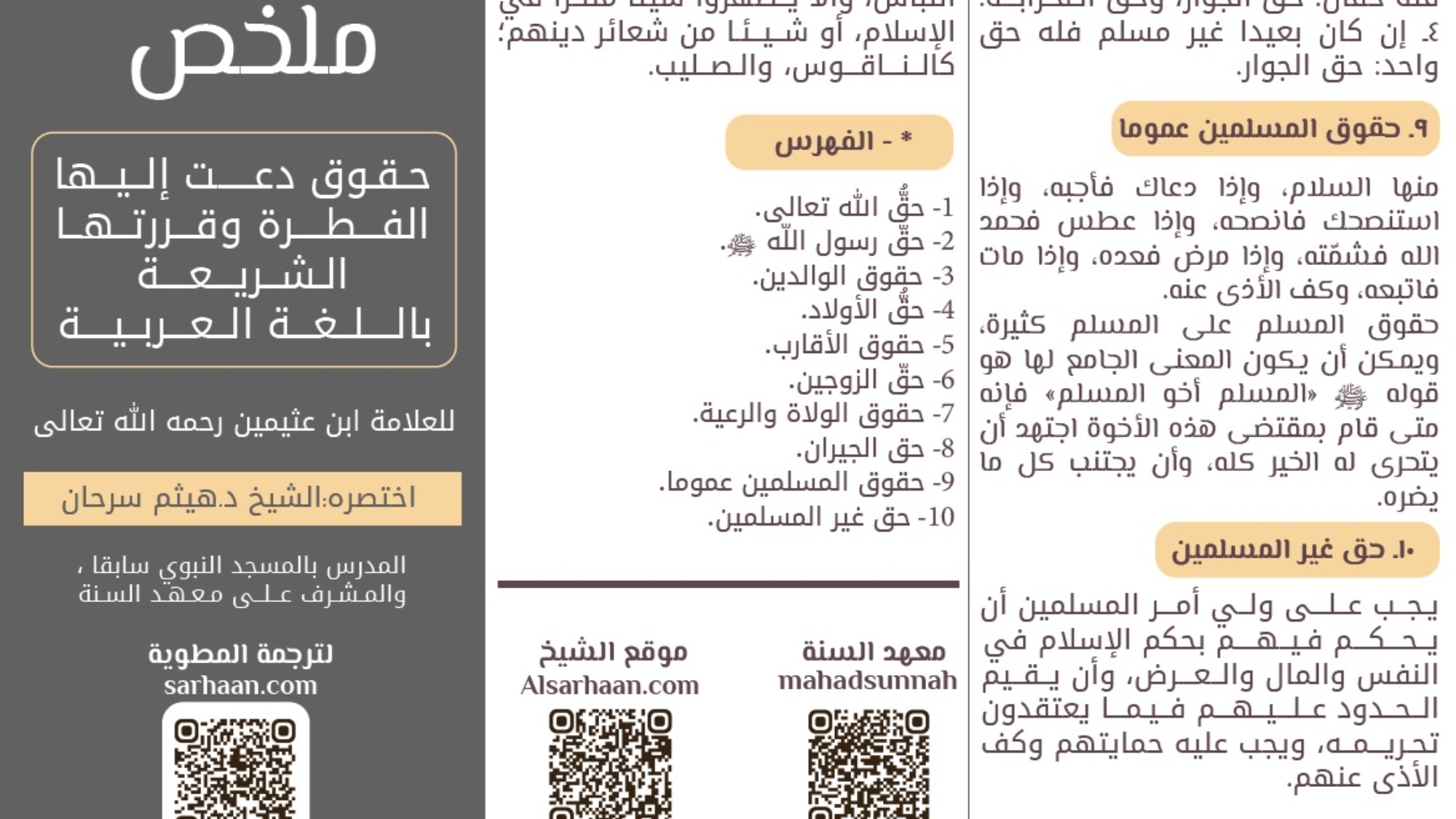
ملخص حُقوق دعت إليها الفطرة وقرَّرتها الشريعة باللغة العربية لابن عثيمين رحمه الله

ملخص حقوق دعت إليها الفطرة:
مطوية باللغة العربية اختصرها الشيخ الدكتور هيثم سرحان من كتاب حقوق دعت إليها الفطرة للعلامة ابن عثيمين رحمه الله، وهو كتاب عظيم في بيان عدالة الشريعة الإسلامية من خلال ضبطها للحقوق، فبدأ بأعظم الحقوق وهو حق الخالق سبحانه وتعالى، ثم حقوق المخلوقين واعظمهم محمد صلى الله عليه وسلم.

1ـ حقُّ الله تعالى

أن تعبده وحده لا شريك له، وتكون عبدًا متذللا خاضعا له، ممتثلا لأمره، مجتنباً لنهيه، مصدِّقا بخبره، عقيدة مثلى، وإيمانٌ بالحق، وعمل صالح مثمر، عقيدة قوامها: المحبة والتعظيم، وثمرتها: الإخلاص والمثابرة.


2ـ حقّ رسول اللّه ﷺ

توقيره، واحترامه، وتعظيمه؛ التَّعظيم اللائق به، من غير غلوٍّ ولا تقصير.

وتصديقه فيما أخبر به من الأمور الماضية والمستقبَلة، وامتثال ما به أمر، واجتناب ما عنه نهى وزجر، والإيمان بأن هديه أكمل الهدي، والدفاع عن شريعته وهديه.


3ـ حقوق الوالدين

تبرهما، وذلك بالإحسان إليهما قولًا وفعلا بالمال والبدن، وتمتثل أمرهما في غير معصية الله، وفي غير ما فيه ضرر عليك.


4ـ حقُّ الأولاد

1ـ التربية؛ وهي تنمية الدين والأخلاق في نفوسهم حتى يكونوا على جانب كبير من ذلك

2ـ أن ينفق عليهم بالمعروف من غير إسراف ولا تقصير

3ـ ألا يفضل أحدا منهم على أحد في العطايا والهبات


5ـ حقوق الأقارب

أن يصل قريبه بالمعروف؛ ببذل الجاه، والنفع البدني، والنفع المالي بحسب ما تتطلبه قوة القرابة والحاجة.

.


6ـ حقّ الزوجين

أَن يعاشر كل منهما الآخر بالمعروف وأن يبذل الحق الواجب له بكل سماحة وسهولة من غير تكرّه لبذله ولا مماطلة.

من حقوق الزوجة على زوجها: أن يقوم بواجب نفقتها من الطعام والشراب والكسوة والمسكن وتوابع ذلك، والعدل ببن الزوجات.

من حقوق الزوج على زوجته: أن تطيعه في غير معصية اللّه، وأن تحفظه في سره وماله، وألا تعمل عملا يضيع عليه كمال الاستمتاع.


7ـ حقوق الولاة والرعية

حقوق الرعية على الولاة: أن يقوموا بالأمانة التي حملهم الله إياها وألزمهم القيام بها من النصح للرعية والسير بها على النهج القويم الكفيل بمصالح الدنيا والآخرة، وذلك باتباع سبيل المؤمنين.

حقوق الولاة على الرعية فهي: النصح لهم فيما يتولاه الإنسان من أمورهم، وتذكيرهم إذا غفلوا، والدعاء لهم إذا مالوا عن الحق، وامتثال أمرهم في غير معصية الله، ومساعدتهم.


8ـ حق الجيران

الجار: هو القريب منك في المنزل، يحسن إليه بما استطاع من المال والجاه والنفع، ويكفّ عنه الأذى القولي والفعلي.

1ـ إن كان قريبا منك في النسب وهو مسلم فله ثلاثة حقوق: حق الجوار، وحق القرابة، وحق الإسلام.

2ـ إن كان مسلما وليس بقريب في النسب فله حقان: حق الجوار، وحق الإسلام

3ـ وكذلك إن كان قريبا وليس مسلما فله حقان: حق الجوار، وحق القرابة

4ـ إن كان بعيدا غير مسلم فله حق واحد: حق الجوار


9ـ حقوق المسلمين عموما

منها السلام، وإذا دعاك فأجبه، وإذا استنصحك فانصحه، وإذا عطس فحمد الله فشمّته، وإذا مرض فعده، وإذا مات فاتبعه، وكف الأذى عنه.

حقوق المسلم على المسلم كثيرة، ويمكن أن يكون المعنى الجامع لها هو قوله ﷺ «المسلم أخو المسلم» فإنه متى قام بمقتضى هذه الأخوة اجتهد أن يتحرى له الخير كله، وأن يجتنب كل ما يضره.


10ـ حق غير المسلمين

يجب على ولي أمر المسلمين أن يحكم فيهم بحكم الإسلام في النفس والمال والعرض، وأن يقيم الحدود عليهم فيما يعتقدون تحريمه، ويجب عليه حمايتهم وكف الأذى عنهم.

ويجب أن يتميزوا عن المسلمين في اللباس، وألا يظهروا شيئا منكرا في الإسلام، أو شيئا من شعائر دينهم؛ كالناقوس، والصليب.


nbook'

Summary of rights called for by Fitrah (instinct/natural disposition) and approved by the Shari’ah (Islamic legislation) in the English language. By Ibn Uthaymeen – may Allah have mercy on him.


1- The rights of Allah the Most High:


To worship Him Alone without any partners, and that you be a humble, submissive worshipper to Him, obeying His commands, avoiding His prohibitions, and believing in what He informed us about. It is a perfect Aqeedah (Islamic creed), belief in the truth, and righteous fruitful deeds. It’s an Aqeedah based on love and glorification; its fruit is sincerity and perseverance.


2- The rights of the Messenger of Allah ﷺ:


The right of the Messenger of Allah ﷺ is to be honored, respected, and glorified appropriately without exaggeration nor deficiency.

Also believing him in what he has informed us about past and future events, doing what he commanded us to do, avoiding what he prohibited, believing that his guidance is the perfect guidance, and defending his Sharee’ah (Islamic legislation) and guidance.


3- The rights of the Parents:


Be righteous to them by treating them with goodness in word and deed, with money and the body, and obeying their commands in that which is not disobedience to Allah and doesn’t cause any harm to you.


4- The rights of children:


1- Upbringing: it is the development of religion and morals in their hearts to a high standard.

2- To spend on them in a reasonable manner, without extravagance nor negligence.

3- Not to give preference to any of them over the other in spending and gifts.


5- The rights of relatives:


To uphold ties of kinship with kindness by using your social position, physical efforts to benefit them, and financially depending on how close and needy they are.


6- The rights of spouses:


To live with each other in a kind manner and give the right that is due to him with tolerance and ease without any compulsion or procrastination in fulfilling each other’s rights.


Among the rights of the wife over her husband: that he fulfils the duty of spending on her in terms of food, drink, clothing, housing and so on, and that he treats all his wives equally.


Among the husband’s rights over his wife: that she obeys him in that which is not disobedience of Allah, protects his secrets and wealth, and does not do something that would spoil his complete enjoyment.


7- The rights of rulers and subjects:


The rights of the subjects on the rulers: to carry out the trust that Allah has given them and obligated upon them, such as advising their subjects and taking them on the right path that guarantees their benefit in this world and the hereafter, and that is by following the path of the believers.


The rights of rulers over the subjects are: advising them in what a person is responsible for in their affairs, reminding them if they become negligent, making Du’a’ (praying) for them if they deviate from the truth, obeying their commands in that which is not disobedience to Allah, and helping them.


8- The rights of the neighbors:


A neighbor is someone who lives close to you. You should be good to him with what you can using money, social position, and help. You should also refrain from any verbal or physical harm.


1- If he is a relative and a Muslim, he has three rights: the right of the neighbor, the right of kinship, and the right of Islam.

2- If he is a Muslim but not a relative, he has two rights: the right of the neighbor and the right of Islam.

3- Likewise, if he is a relative and is not a Muslim, he has two rights: the right of the neighbor and the right of kinship.

4- If he is not related and is a non-Muslim, he has only one right: the right of the neighbor.


9- The rights of Muslims in general:


From them is: giving Salam; if he invites you, accept the invitation; if he asks you for advice, advise him; if he sneezes and says ‘Alhamdulillah’, say ‘Yarhamukallah’; if he is sick, visit him; if he dies, follow his funeral; avoid causing him any harm.


The rights of a Muslim over a Muslim are many, and they can be summarized in meaning by the Prophet’s ﷺ saying: “A Muslim is a brother to a Muslim.”  Fulfilling the requirements of this brotherhood will make a person strive to seek all goodness for his Muslim brother and avoid anything that harms him.


10-The rights of non-Muslims:


A Muslim ruler must rule over them with the law of Islam in their lives, wealth, and honor, set limits on them according to what is Haram (forbidden), and he must protect them and not harm them.


The disbelievers must be distinguished from Muslims in dress code. Also, they must not show (i.e., publicly) anything objectionable in Islam or any of the rituals of their religion, like the bell or the cross.


حصن بوسنية

Hisnul-Muslimi ( zaštita svakog muslimana )

حصن المسلم

Skraćeno izdanje knjige ’Zikr, dova i liječenje sa šerijatskom rukjom iz Kur’ana i Sunneta’. Knjigu je skratio sam pisac te se pri tome bazirao na poglavlje o zikru kako bi knjižica bila lagana za čitati i pamtiti. Na kraju, zadovoljava se pomenom zikra tj. metna, te pominje izvor ili dva od knjiga hadisa. Onaj ko želi da sazna nešto više o ashabu koji prenosi hadis ili bilo što drugo vezano za istog neka se vrati na knjigu tj. potpuno izdanje.

WhatsApp Image 2021-08-12 at 1.46.32 PM

Mburoja e muslimanit – Lutje nga Kurani dhe Suneti

حصن المسلم

Mburoja e muslimanit është ndër librat më të njohur në mesin e muslimanëve. Në të janë përfshirë dhikri dhe lutjet që e ruajnë muslimanin nga shejtanët dhe xhinët dhe e forcojnë lidhjen e tij me Allahun. Në të gjenden shumica e lutjeve që i nevojiten muslimanit gjatë ditës dhe natës.