

Allaha necə qul ola bilərsən

Allaha necə qul ola bilərsən
Biography of Sheikh Dr. Haytham Sarhaan – Teacher at the Masjid of the Prophet ﷺ previously, and currently the supervisor over Mahad Sunnah
الإنجليزية
English
A brief biography of Shaykh Haytham Sarḥān Electronic Edition – Version 1.00
Tuesday 23 August, 2022
Copyright © 2022 – Madeenah.com
All Rights Reserved*
No part of this publication may be reproduced, stored in a retrieval system or transmitted in any form or by any means, electronic, mechanical, photocopying, recording or otherwise without the prior written permission of the copyright owner; *Except for one who wishes to charitably print and freely distribute this publication, “as is” – strictly without change, solely
). ُس ْب َحان ُه َو َت َعال( Allaah of Pleasure the seeking
“So whoever hopes for the Meeting with his Lord, let him work righteousness and associate none as a partner in the worship of his Lord.”
The Noble Qur.aan – Soorah al-Kahf, Aayah 110
05 English Islam – Ma’had As-Sunnah Supervised by Dr. Haytham Sarhaan
📚 Learn Islam through online classes, educational videos, Arabic lessons, children’s content, free book downloads, and da‘wah resources.
📺
🌐 http://mahadsunnah.com/
📘 https://www.facebook.com/profile.php?id=100063611231801
📲 https://t.me/Englishooooooo
📚 https://sarhaan.com/a/الإنجليزية-english/
📷 https://instagram.com/english__islam_mahad_al_sunna?igshid=MmIzYWVlNDQ5Yg==
🐦 https://twitter.com/mahadas_sunnah?s=11&t=0kffUO9uzhjFITlTEZ-VHQ
📱 https://whatsapp.com/channel/0029Va8qEP665yD2gOencl1h
🎵 https://www.tiktok.com/@drhaythamsarhan?_t=8hfNNlRM4N4&_r=1
#Islam #Learning #OnlineEducation #Dawah #Children #ArabicLanguage #FreeBooks #ImportantLessons #UsoolThalatha #Seerah
انشر تؤجر
#Islam #IslamicEducation #LearnIslam #IslamOnline #IslamicStudies #IslamicKnowledge #IslamicLearning #OnlineIslam #IslamicInstitute #IslamicAcademy #IslamicSchool #MahadAsSunnah #MahadSunnah #SunnahInstitute #AhlusSunnah #FollowingSunnah #QuranAndSunnah #AuthenticIslam #TrueIslam #PureIslam #IslamicDawah #DawahOnline #InviteToIslam #SpreadIslam #GlobalDawah #DigitalDawah #IslamForAll #IslamForBeginners #IslamForKids #IslamicKids #MuslimChildren #IslamicParenting #ArabicLanguage #LearnArabic #ArabicOnline #ArabicForBeginners #Quran #QuranStudies #Tafsir #Hadith #Fiqh #Aqidah #Tawheed #UsoolThalatha #Seerah #ProphetMuhammad #IslamicVideos #IslamicLectures #IslamicClips #IslamicContent #IslamicMedia #IslamicYouTube #IslamicTikTok #IslamicInstagram #IslamicFacebook #IslamicReels #IslamicShorts #ShortIslam #EducationalContent #OnlineClasses #DistanceLearning #Elearning #FreeIslamicBooks #FreeBooks #IslamicLibrary #IslamicResources #IslamicWebsite #MuslimEducation #MuslimCommunity #IslamicGuidance #SeekingKnowledge #KnowledgeIsLight #Faith #Iman #Worship #SpiritualGrowth #IslamicLifestyle #SalafiManhaj #ManhajSalaf #IslamicCreed #SoundAqidah #CorrectBelief #Tazkiyah #IslamicEthics #IslamicManners #IslamicHistory #StoriesOfProphets #DailyReminder #LessonsForLife #MuslimYouth #NewMuslims #RevertSupport #IslamWorldwide #OnlineUmmah #Sarhaan #SarhaanBooks #SarhaanLibrary #SarhaanMedia #DrHaythamSarhaan #HaythamSarhaan
#Music
#Art
#Culture
#Media
#DigitalMedia
#SocialMedia
#OnlineCommunity
#ContentCreation
#CreativeContent
#VideoContent
#AudioContent
#Podcast
#MusicLovers
#ArtLovers
#CreativeMind
#Creativity
#Inspiration
#Motivation
#DailyInspiration
#LifeLessons
#Lifestyle
#ModernLife
#HealthyLifestyle
#Mindset
#PositiveMindset
#MentalHealth
#Wellbeing
#InnerPeace
#SelfImprovement
#PersonalGrowth
#Education
#Learning
#Knowledge
#GeneralKnowledge
#OpenDiscussion
#PublicForum
#CommunityTalk
#Trending
#ViralContent
#HotTopics
#Discussion
#Debate
#Opinions
#Ideas
#Thoughts
#Perspective
#WorldView
#Society
#SocialIssues
#HumanValues
#Ethics
#Morality
#Respect
#Dialogue
#Communication
#Language
#Languages
#Translation
#Writing
#Reading
#Books
#BookLovers
#Literature
#Poetry
#History
#WorldHistory
#Heritage
#Civilization
#Philosophy
#CriticalThinking
#Science
#Technology
#Tech
#Innovation
#DigitalLife
#InternetCulture
#OnlineWorld
#GlobalCommunity
#WorldWide
#People
#Humanity
#Youth
#NextGeneration
#Future
#Awareness
#SocialAwareness
#MediaAwareness
#CreativeForum
#OpenMind
#FreeDiscussion
#ShareIdeas
Compiled by
Abul Abbaas Naveed Ayaaz
Publisher
Madeenah.com
al-Madeenah an-Nabawiyyah Saudi Arabia
eMail: [email protected]
3
“
He is known for his
efforts in teaching books to individu- als, small groups as well large con- gregations with an emphasis on Mutūn (texts) and in particular the
explanations of Ibn
‘Uthaymīn.
In the name of Allāh, the most Merciful, the Bestower of mercy.
Name
He is our Shaykh and Murabbi, Abu Abdillah Haytham Ibn Muḥammad Jamīl Sarḥān.
Birth
1391h, corresponding to 1971.
City
He was born in the city of Jeddah, Saudi Arabia, and then moved to al-Madῑnah an-Nabawiyyah, where he currently resides.
Seeking knowledge
Before moving to Madῑnah, the Shaykh sought knowledge from the scholars in Jeddah, as well as frequently travelling between Jeddah and Makkah. He also gained an Ijāza in Qur’ān (Ḥafs from ‘Āsim) as well as various Ijāzāt in Ḥadīth, Tawḥīd and Farāid.
Scholars he studied with
• Shaykh Ibn ‘Uthaymīn: He would travel to al-Ḥaram al-Makki to study with the Shaykh during the seasons in which Ibn ‘Uthaymīn would reside and teach in Makkah.
• Shaykh AbdulMuḥsin al-Abbād: after moving to Madῑnah, he devoted a number of years in studying the books of Sunnan with the Shaykh in al-Masjid an-Nabawi.
• Shaykh Muḥammad Ibn ‘AbdulWahhāb al-Banna, in Jeddah.
• Shaykh ‘Umar Muḥammad Fullātah, in al-Masjid an-Nabawi.
• Shaykh ‘Atiyyah Sālim, in al-Masjid an-Nabawi.
• Shaykh Muḥammad Hamūd al-Wāili, in al-Masjid an-Nabawi.
• Shaykh ‘Ammār ibn Mukhtār al-Akhdari & Shaykh Sa’īd Ibn Hamūd al-Juhani: He studied the laws of inheritance with them in al-Masjid an-Nabawi.
• He also attended lessons and gatherings with Shaykh Ibn Bāz, and met with Shaykh Muḥammad Nāṣirud-Deen al-Albāni who gifted him the first copy of his book: “Taḥrīm Ālāt At-Tarb” lit. “the Impermissibility of Musical Instruments”.
4
Students are pro- hibited from writ- ing or taking notes during the lesson, rather they are encouraged to lis- ten attentively and memorise. After the lesson, the students would sit together and write the les- son notes from their memory.
His efforts and roles in teaching and Da’wah
• He was appointed as the Imām and Khatīb at Jāmi’ Masjid in Bani Mālik, Jeddah.
• He was appointed as a teacher in al-Ma’had al-Ḥaram in al- Masjid an-Nabawi in the year 1428h, wherein he taught ‘Aqīdah, Fiqh and Farāid.
• In 1432h, he was invited to participate in the annual summer Dawrah ‘Ilmiyyah in al-Masjid an-Nabawi, wherein he taught Kitāb at-Tawḥīd.
• He has taught numerous books in Masjid Dhu-Nurayn and Masjid al-Ghamāmah in Madīnah.
• He has travelled to various small towns and villages within Saudi Arabia to give Da’wah.
• He was appointed a Da’ee by the Ministry of Islamic Affairs and Awqāf in 1430h.
Books which he has taught
He has taught books and texts across the various branches of Islamic knowledge, including:
• In Aqīdah: The treatise’ of Imām Muḥammad Ibn AbdilWahhāb, including al-Uṣūl ath-Thalātha, al-Qawā’id al-Arba’, al-Uṣūl as- Sittah, Kitāb at-Tawḥīd, Nawāqid al-Islām as well as other well- known treatise such as al-Aqīdah al-Wāsitiyyah, at-Taḥāwiyyah, at-Tadmuriyyah, al-Ḥamawiyyah and Sullam al-Wuṣūl by al- Ḥakami etc.
• In Fiqh: Ad-Durūs al-Muhimmah, Manhaj as-Sālikīn and Zād al- Mustaqni’.
• In Uṣūl al-Fiqh: Naẓm al-Waraqāt, al-Uṣūl min ‘ilm al-Uṣūl, al- Qawā’id al-Fiqhiyyah and ar-Raḥabiyyya (in al-Farāid).
• Ādāb: Naẓm Ḥilyat Tālib al-Ilm, al-Manẓūmat al-Mīmiyyyah etc.
The shaykh has taught each one of these books many times over.
Books which he has authored
• Al-Mukhtaṣar al-Mufīd li sīrat an-Nabi al-Muṣtafā.
• At-Taqsīm wat-Taq’īd lil Qawl al-Mufīd.
• Sharḥ matn ad-Durūs al-Muhimmma li ‘Āamatil Ummah.
• Sharḥ al-Uṣūl ath-Thalāthah
• Sharḥ al-Uṣūl as-Sittah
• Sharh Manhaj as-Sālikīn
• Mutūn Tālib al-ilm
That which I know, is that he is a man who strived to [learn and] sit with the scholars, he has knowledge regarding the cor- rect ‘Aqīdah and
[knowledge-based]
issues…
In addition to the above books which he has authored, some of his books, lectures and articles have been translated into over 50 languages including English, Albanian, Amharic, Bangla, German, French, Indonesian, Kurdish, Norwegian, Persian, Romanian, Russian, Swedish and Urdu.1
His books translated into English include:
• Gateway to understanding Aqīdah, Fiqh, Sīrah & Tafsīr.
• A Concise Biography of the Prophet H and His Special Traits.
• Explanation of the Important lessons for Every Muslim.
• Fiqh of Fasting, Zakat al-Fitr and ‘Eid [leaflet].
• An explanation of al-Uṣūl ath-Thalātha.
• An explanation of Nawāqid al-Islām.
• An explanation of al-Qawādi’ al-Arbā’.
• I play and learn.
His websites
He is the supervisor of two websites, they are:
1. https://www.alsarhaan.com/
This website contains the books and lessons of the Shaykh as well as other scholars of Madinah.
2. https://mahadsunnah.com/
A free online learning platform through which a student can progress through the Islamic sciences.
His teaching style
He is known for his efforts in teaching books to individuals, small groups as well large congregations with an emphasis on Mutūn (texts) and in particular the explanations of Ibn ‘Uthaymīn. Students are prohibited from writing or taking notes during the lesson, rather they are encouraged to listen attentively and memorise. After the lesson, the students would sit together and write the lesson notes from their memory.
6
Shaykh Haytham Sarḥān is a virtu- ous man, and from the best of the Salafi students of
knowledge.
His classes are disciplined, and the correct etiquettes must be maintained at all times. Each student is required to memorise the Matn, and revise previous work – with the threat of the lesson being cancelled at an instance if the matn has not been memorised or revised.
During his first years of teaching in al-Masjid an-Nabawi, the Shaykh would divide his students into small groups of 4 or 5 students, and each group would be taught every day for 20 minutes. As his lessons became more popular, and the space afforded to him in al-Masjid an-Nabawi became crowded, he was given a dedicated place in Masjid Dhu-Nurayn.
The praise of the scholars2
Shaykh Wasīullah al-Abbās: “That which I know, is that he is a man who strived to [learn and] sit with the scholars, he has knowledge regarding the correct ‘Aqīdah and [knowledge-based] issues…”
Shaykh Sāliḥ as-Suḥaymī: “Shaykh Haytham Sarḥān is a virtuous man, and from the best of the Salafi students of knowledge.”
Shaykh Falāḥ Ismā’īl: “As for Shaykh Haytham Sarḥān, we do not know him except to be a Mujāhid in this field (da’wah), he has great efforts, tolerance and travelling to countries; he travels East and West; in fact he aids students to travel to Madīnah, and live in Madīnah to learn, seek knowledge and then return to their countries. The world bears witness to his lessons. His lessons and lectures are all books of the Salaf, so where is the hizbiyyah?! …the man is known to us to be upon the Sunnah, and the books he teaches are the books of the Sunnah…”
Shaykh ‘Ali at-Tuwijirī: “The brother, Haytham Sarḥān is known to me, I know him personally, he is from our trustworthy brothers, he traverses the Salafi methodology, well-grounded in knowledge; he has devoted himself to the lessons of our Shaykh ’AbdulMuḥsin al- Abbād; and has also devoted himself to teaching students…”
7
…we do not know him except to be a Mujāhid in this field (da’wah), he has great efforts,
tolerance and trav- elling to countries; he travels East and West; in fact he aids students to travel to Madīnah,
and live in Madīnah to learn, seek knowledge and then return to their countries.
There is a lot more to be written regarding his Da’wah efforts, his character, his sacrifices, his unique relationship with his students throughout the world as well as my personal experiences and interactions with him spanning over 15 years. However, ultimately it is a person’s own knowledge, good deeds and efforts which praise him, and what has been written is sufficient for now. Nobody is praised above Allāh, and our accountability is with Him alone. Wallāhu a’lam.3
Compiled by,
Abul Abbaas Naveed Ayaaz Nelson, Lancashire
24th Muharram, 1444h Corresponding to 21st August, 2022.
8
The brother, Hay- tham Sarḥān is known to me, I know him person- ally, he is from our trustworthy broth- ers, he traverses the Salafi method- ology, well-ground-
Hỡi những ai đã bỏ Hajj,thÌ đừng bỏ lỡ điều này
phúc đức của sahabah và quyền lợi của Họ
Tin vào May Rủi

Về giáo luật viếng mộ
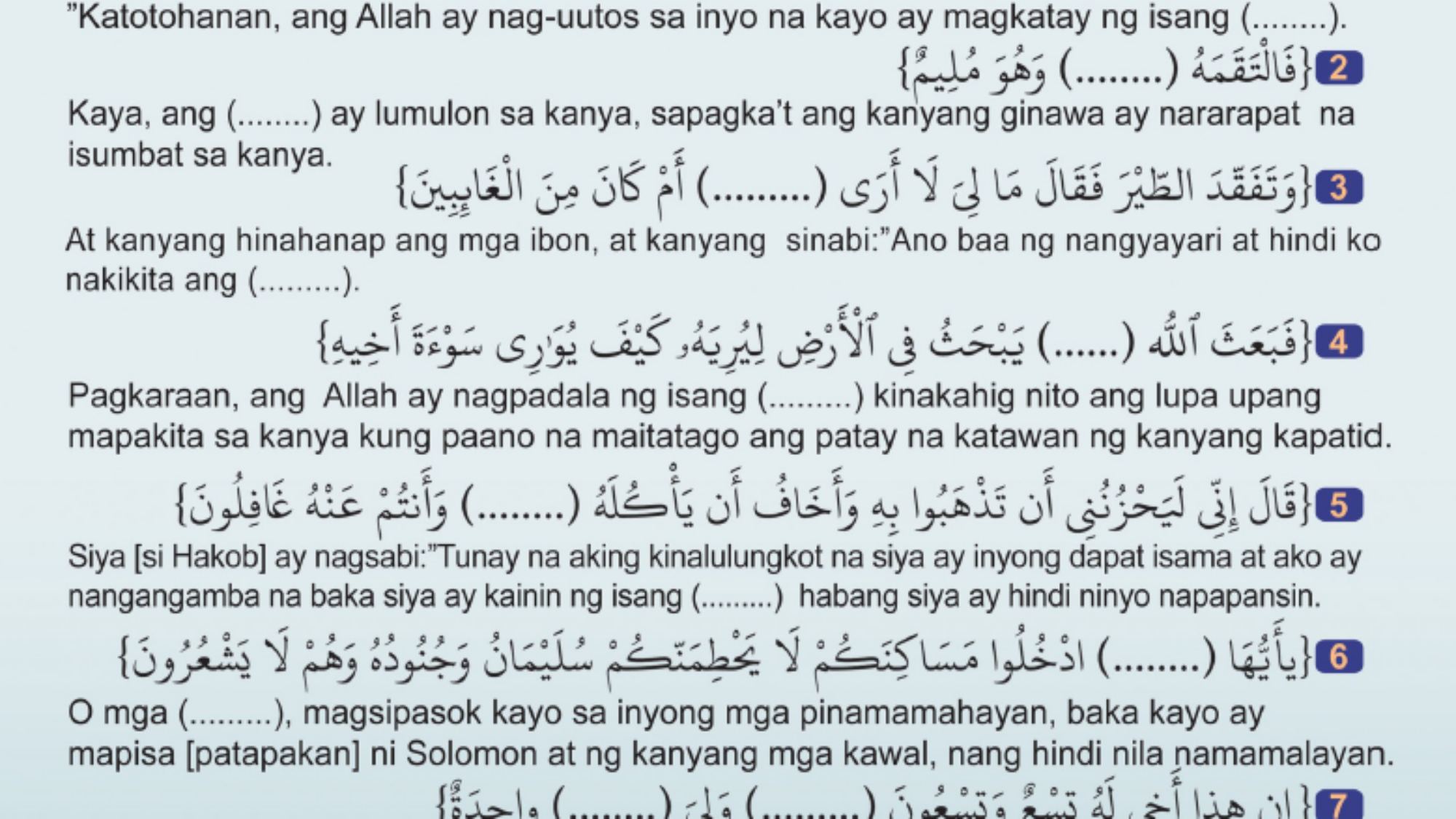
Ilagay ang pangalan ng hayop o ibon sa patlang
1- {(……..)وَإِذْ قَالَ مُوسَىٰ لِقَوْمِهِ إِنَّ اللَّهَ يَأْمُرُكُمْ أَن تَذْبَحُوا }
1- At inyong alalahanin nang sabihin ni Moises sa kanyang mga mamamayan:”Katotohanan, ang Allah ay nag-uutos sa inyo na kayo ay magkatay ng isang (……..).
2- {فَالْتَقَمَهُ (……..) وَهُوَ مُلِيمٌ}
2-Kaya, ang (……..) ay lumulon sa kanya, sapagka’t ang kanyang ginawa ay nararapat na isumbat sa kanya.
3- {وَتَفَقَّدَ الطَّيْرَ فَقَالَ مَا لِيَ لَا أَرَى (………) أَمْ كَانَ مِنَ الْغَائِبِينَ}
3-At kanyang hinahanap ang mga ibon, at kanyang sinabi:”Ano baa ng nangyayari at hindi ko nakikita ang (………).
4- {فَبَعَثَ ٱللَّهُ (……) يَبْحَثُ فِى ٱلْأَرْضِ لِيُرِيَهُۥ كَيْفَ يُوَٰرِى سَوْءَةَ أَخِيهِ} ۚ
4-Pagkaraan, ang Allah ay nagpadala ng isang (………) kinakahig nito ang lupa upang mapakita sa kanya kung paano na maitatago ang patay na katawan ng kanyang kapatid.
5- {قَالَ إِنِّي لَيَحْزُنُنِي أَن تَذْهَبُوا بِهِ وَأَخَافُ أَن يَأْكُلَهُ (……..) وَأَنتُمْ عَنْهُ غَافِلُونَ}
5-Siya [si Hakob] ay nagsabi:”Tunay na aking kinalulungkot na siya ay inyong dapat isama at ako ay nangangamba na baka siya ay kainin ng isang (………) habang siya ay hindi ninyo napapansin.
6- {يأَيُّهَا (……..) ادْخُلُوا مَسَاكِنَكُمْ لَا يَحْطِمَنَّكُمْ سُلَيْمَانُ وَجُنُودُهُ وَهُمْ لَا يَشْعُرُونَ}
6- O mga (………), magsipasok kayo sa inyong mga pinamamahayan, baka kayo ay mapisa [patapakan] ni Solomon at ng kanyang mga kawal, nang hindi nila namamalayan.
7- {ان هذا أَخِي لَهُ تِسْعٌ وَتِسْعُونَ (………) وَلِيَ (……..) واحِدَةٌ}
7-Katotohanan, itong aking kapatid ay nagmamay-ari ng siyamnaput siyam na (………) , samantalang ako ay may isang(………) lamang.
8- { فَمَثَلُهُۥ كَمَثَلِ (…….) إِن تَحْمِلْ عَلَيْهِ يَلْهَثْ أَوْ تَتْرُكْهُ يَلْهَث}
8-Kaya ang kanyang kahalintulad ay isang (………) : kung ito ay iyong itataboy , kanyang inilalawit ang kanyang dila.
9- { (…….)أَلَمْ تَرَى كَيْفَ فَعَلَ رَبُّكَ بِأَصْحَابِ }
9-Hindi mo pa isinaalang-alang[ang kasaysayan] kung papaano pinakitunguhan ng iyong panginoon ang mga kasamahang [sakay ng] (………).
10- { كَأَنَّهُمْ (……..) مُسْتَنْفِرَةٌ * فَرت من (……..) }
10-Wari bang sila ay mga nangatatakot na (………), Na tumatakas mula sa bangis ng (………).
11- {فَأَلْقَىٰ عَصَاهُ فَإِذَا هِيَ (…….) مُّبِينٌ}
11-Kaya, inihagis ni Moises ang kanyang tungkod at kapagdaka, ito ay naging isang lantad na (………).
12- {مَثَلُ الَّذِينَ حُمِّلُوا التَّوْرَاةَ ثُمَّ لَمْ يَحْمِلُوهَا كَمَثَلِ (…….)ِ يَحْمِلُ أَسْفَارًا}ۚ
12-Ang kahalintulad niyaong mga taong pinagkatiwalaan ng Torah subali’t pagkaraan ay hindi nagawang tuparin ang tungkulin para rito, ay tulad ng isang(………) na nagpapasan ng mabibigat na aklat subalit walang nauunawaan dito.
13- {وَيَا قَوْمِ هَٰذِهِ (…….) اللَّهِ لَكُمْ آيَةً فَذَرُوهَا تَأْكُلْ فِي أَرْضِ اللَّهِ وَلَا تَمَسُّوهَا بِسُوءٍ}
13-At O aking nga mamayanan! Ito ang babaing (………) ng Allah, ito ay isang tanda para sa inyo. Kaya,hayaan sila na manalangin sa lupain ng Allah, at huwag na ninyong dulutan ito ng pananakit.
14- {وَأَوْحَىٰ رَبُّكَ إِلَى (…….) أَنِ اتَّخِذِي مِنَ الْجِبَالِ بُيُوتًا وَمِنَ الشَّجَرِ وَمِمَّا يَعْرِشُونَ}
14-At ang iyong Panginoon ay nagbigay- inspirasyon sa mga (………) :”Kunin at manirahan kayo sa mga bundok at sa mga punongkahoy at sa anumang kanilang itinatayo bilang pagpupuguran.
15- {فَأَرْسَلْنَا عَلَيْهِمُ الطُّوفَانَ وَ(…….) وَ(…….) وَ(…….) وَالدَّمَ آيَاتٍ مُّفَصَّللَاتٍ فَاسْتَكْبَرُوا وَكَانُوا قَوْمًا مُّجْرِمِينَ}
15- {فَأَرْسَلْنَا عَلَيْهِمُ الطُّوفَانَ وَ(…….) وَ(…….) وَ(…….) وَالدَّمَ آيَاتٍ مُّفَصَّللَاتٍ فَاسْتَكْبَرُوا وَكَانُوا قَوْمًا مُّجْرِمِينَ}
15-Kaya Aming ipinadala sa kanila: ang baha,ang mga(………) , ang mga (………) , at mga (………), at dugo bilang mga malilinaw na palatandaan, subali’t sila ay nanatiling mapagmalaki, at sila yaong mga taong mapaggawa ng kabuktutan.
16- {مَثَلُ الَّذِينَ اتَّخَذُوا مِنْ دُونِ اللَّهِ أَوْلِيَاءَ كَمَثَلِ (…….) اتَّخَذَتْ بَيْتًا}
16-Ang kahalintulad niyaong mga nagtuturing ng ibang awliyah[tagapangalaga] bukod sa Allah ay katulad ng isang (………) na gumawa ng isang bahay.
17- {فَلَمَّا عَتَوْا عَمَّا نُهُوا عَنْهُ قُلْنَا لَهُمْ كُونُوا (…….) خَاسِئِينَ}
17-Kaya nang sila ay naging marahas tungkol sa anumang bagay na sa kanila ay ipinagbabawal, Aming sinabi sa kanila:”Kayo ay maging (………) na kinamuhian.
18- {أَفَلا يَنْظُرُونَ إِلَى (……)ِ كَيْفَ خُلِقَتْ}
18-Kaya, hindi ba sila sumusulyap sa (………) –kung papaano sila nilikha?
19- {خُشَّعًا أَبْصَارُهُمْ يَخْرُجُونَ مِنَ الْأَجْدَاثِ كَأَنَّهُمْ (…….)ٌ مُّنتَشِرٌ}
19- Ang kanilang mga mata ay nangayupapa, sila ay magsisilabasan mula sa mga libingan na wari bang sila ay mga (………) na naglilipana.
20- {يَوْمَ يَكُونُ النَّاسُ (…….) الْمَبْثُوثِ}
20-[Ito ang] Araw na ang tao ay magiging tulad ng mga (………) na nangagkalat.
21- { و (……)(…….)مَنْ لَعَنَهُ اللَّهُ وَغَضِبَ عَلَيْهِ وَجَعَلَ مِنْهُمُ َ}
21- Sila ay kabilang sa mga sinumpa ni Allah at kinapoota, at sila ay ginawa niyang mga (………) at mga (………).
22- {فَرَاغَ إِلَىٰ أَهْلِهِ فَجَاءَ (……) سَمِينٍ}
22-Pagkaraan, siya ay sumaglit sa kanyang mag-anak, at dumating na may dala-dalang isang inihaw na matabang (………) .
23- {فَأَلْقَاهَا فَإِذَا هِيَ (…….) تَسْعَىٰ}
23- Kaya, ito ay kanyang inihagis sa ibaba, at kapagdaka, ito ay (………) na mabilis gumagalaw.
24- {ثَمَانِيَةَ أَزْوَاجٍ ۖ مِّنَ (……) اثْنَيْنِ وَمِنَ (……) اثْنَيْنِ}
24- Mayroong walong magkapares: sa (………) ay dalawa (………) ay dalawa.
25- {إِنَّ اللَّهَ لَا يَسْتَحْيِي أَن يَضْرِبَ مَثَلًا مَّا (……) فَمَا فَوْقَهَا}ۚ
25- Katotohanan, ang Allah ay hindi nakikimig maglahad ng paghahalintulad [na may mabuting aral] maging ito man ay maging kasing liit ng (………) o higit [na mas maliit] kasya rito.
26- {قَالُوا نَفْقِدُ صُوَاعَ الْمَلِكِ وَلِمَن جَاءَ بِهِ حِمْلُ (……)ٍ وَأَنَا بِهِ زَعِيمٌ}
26-Sila ay nagsabi:”Nawala sa amin ang [gintong] mangkok ng hari sinumang makapaglabas nito ay may nakalaang gantimpalang katumbas ng isang hakot (………) at ako ay naatasan para rito”.
27- {إِنَّهَا تَرْمِي بِشَرَرٍ كَالْقَصْرِ كَأَنَّهُ (…….) صُفْرٌ}
27- Katotohanan, ito ay bumubuga ng tilamsik ng apoy na kasinlaki ng isang palasyo, Na wari bang mga kawan ng naninilaw na (………).
28- {قالَ هِيَ عَصايَ أَتَوَكَّؤُا عَلَيْها وَأَهُشُّ بِها عَلى(…….) وَلِيَ فِيها مَآرِبُ أُخْرى}
28-Siya ay sumagot :’’ Ito ay aking tungkod, aking hinihiligan ito, at aking gamit sa pagtigpas ng dahoon para sa aking mga (………) at sa iba pang aking kagamitan”.
29- {إِنَّ الَّذِينَ تَدْعُونَ مِن دُونِ اللَّهِ لَن يَخْلُقُوا (……..) وَلَوِ اجْتَمَعُوا لَه}
29- Katotohanan yaong inyong mga tinatawagan at dinadalanginan bukod sa Allah ay hindi kailanman makalilikha ng kahit isang (………) kahit sila ya magsama-sama para rito.
27- {إِنَّهَا تَرْمِي بِشَرَرٍ كَالْقَصْرِ كَأَنَّهُ (…….) صُفْرٌ}
27- Katotohanan, ito ay bumubuga ng tilamsik ng apoy na kasinlaki ng isang palasyo, Na wari bang mga kawan ng naninilaw na (………).
28- {قالَ هِيَ عَصايَ أَتَوَكَّؤُا عَلَيْها وَأَهُشُّ بِها عَلى(…….) وَلِيَ فِيها مَآرِبُ أُخْرى}
28-Siya ay sumagot :’’ Ito ay aking tungkod, aking hinihiligan ito, at aking gamit sa pagtigpas ng dahoon para sa aking mga (………) at sa iba pang aking kagamitan”.
29- {إِنَّ الَّذِينَ تَدْعُونَ مِن دُونِ اللَّهِ لَن يَخْلُقُوا (……..) وَلَوِ اجْتَمَعُوا لَه}
29- Katotohanan yaong inyong mga tinatawagan at dinadalanginan bukod sa Allah ay hindi kailanman makalilikha ng kahit isang (………) kahit sila ya magsama-sama para rito.
30- {وَأَعِدُّوا لَهُم مَّا اسْتَطَعْتُم مِّن قُوَّةٍ وَمِن رِّبَاطِ (. … ..)ِ تُرْهِبُونَ بِهِ عَدُوَّ اللَّهِ وَعَدُوَّكُمْ}
30- At lagi kayong maghanda laban sa kanila ng anumang inyong kakayahan sa pamamagitan ng lakas at ng mga (………) upang sa pamamagitan nito ay inyong sindakin ang mga kaaway ng Allah at inyong mga kaaway.
Thăm viếng mọi người làvấn đề cần thiết
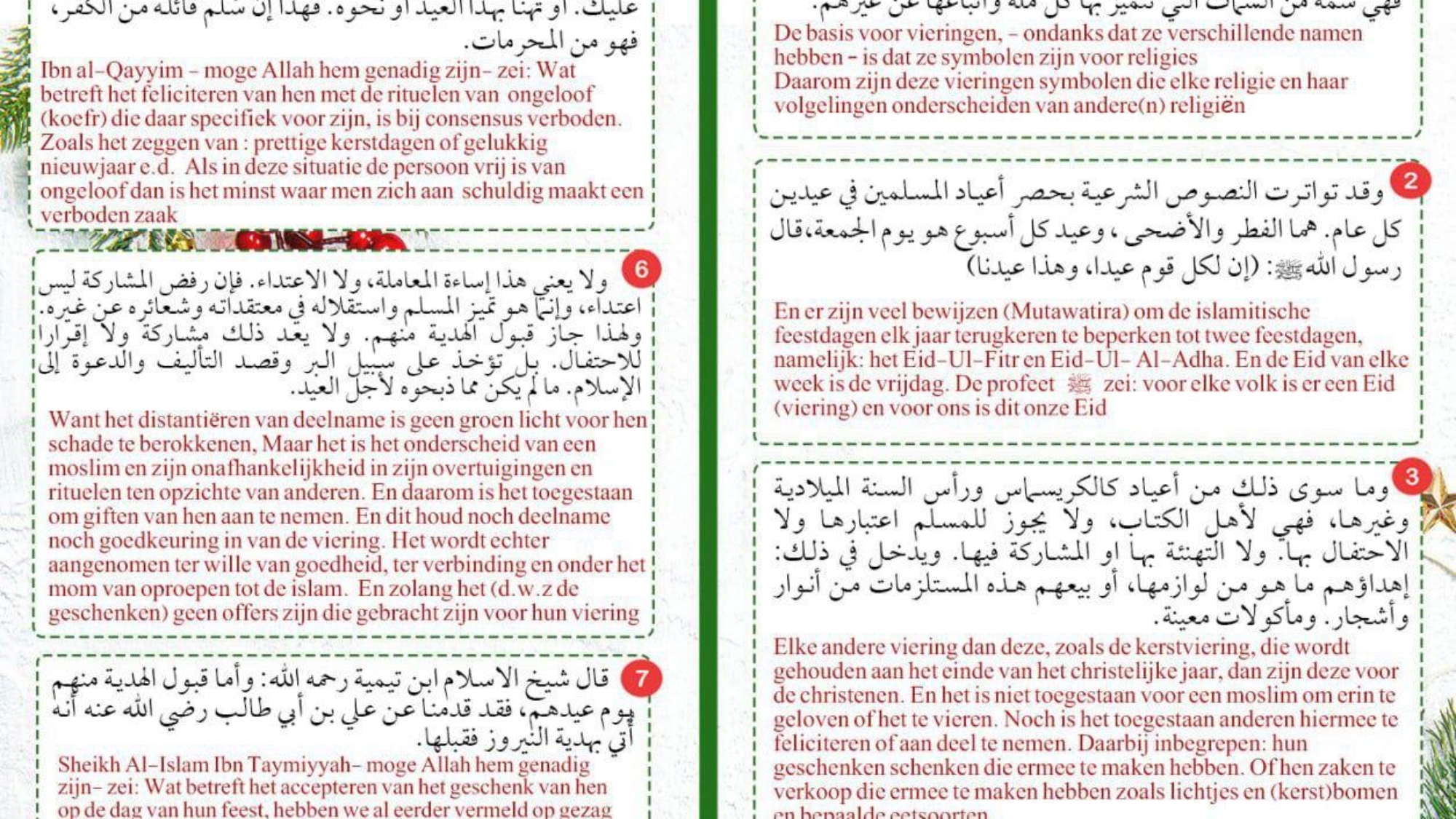
De basis voor vieringen, – ondanks dat ze verschillende namen hebben – is dat ze symbolen zijn voor religies.
Daarom zijn deze vieringen symbolen die elke religie en haar volgelingen onderscheiden van andere(n) religiën.
En er zijn veel bewijzen (Mutawatira) om de islamitische feestdagen elk jaar terugkeren te beperken tot twee feestdagen, namelijk: het Eid-Ul-Fitr en Eid-Ul- Al-Adha.
En de Eid van elke week is de vrijdag.
De profeet ﷺ zei: voor elke volk is er een Eid (viering) en voor ons is dit onze Eid.
Elke andere viering dan deze, zoals de kerstviering, die wordt gehouden aan het einde van het christelijke jaar, dan zijn deze voor de christenen.
En het is niet toegestaan voor een moslim om erin te geloven of het te vieren.
Noch is het toegestaan anderen hiermee te feliciteren of aan deel te nemen.
Daarbij inbegrepen: hun geschenken schenken die ermee te maken hebben.
Of hen zaken te verkoop die ermee te maken hebben zoals lichtjes en (kerst)bomen en bepaalde eetsoorten.
Want dit is verboden om twee redenen:
Ten eerste: Dit is een imitatie van hen en een bevestiging van hun ongeloof, en de islam heeft verboden om de ongelovigen te imiteren in wat een van hun kenmerken is.
en tweede: Het is een innovatie in de religie van de Allah (de Verhevene)
Ibn al-Qayyim – moge Allah hem genadig zijn- zei: Wat betreft het feliciteren van hen met de rituelen van ongeloof (koefr) die daar specifiek voor zijn, is bij consensus verboden.
Zoals het zeggen van : prettige kerstdagen of gelukkig nieuwjaar e.d.
Als in deze situatie de persoon vrij is van ongeloof dan is het minst waar men zich aan schuldig maakt een verboden zaak.
En dit betekent niet dat men slecht met hen moet zijn in de omgang of hen schade berokkenen.
Want het distantiëren van deelname is geen groen licht voor hen schade te berokkenen, Maar het is het onderscheid van een moslim en zijn onafhankelijkheid in zijn overtuigingen en rituelen ten opzichte van anderen.
En daarom is het toegestaan om giften van hen aan te nemen.
En dit houd noch deelname noch goedkeuring in van de viering.
Het wordt echter aangenomen ter wille van goedheid, ter verbinding en onder het mom van oproepen tot de islam.
En zolang het (d.w.z de geschenken) geen offers zijn die gebracht zijn voor hun viering.
Sheikh Al-Islam Ibn Taymiyyah- moge Allah hem genadig zijn- zei: Wat betreft het accepteren van het geschenk van hen op de dag van hun feest, hebben we al eerder vermeld op gezag van Ali bin Abi Talib- moge Allah tevreden met hem zijn- dat hij een geschenk op de dag van Nowruz (Perzisch nieuwjaars- en voorjaarsfeest) had gekregen, en deze accepteerde.
En op gezag van Abi Barzah had hij inwoners die Magiërs waren, en ze gaven hem geschenken op Newroz en een ander viering. En hij zei altijd tegen zijn familie: “Als het iets van fruit is, [neem het aan en] eet ervan. En zo niet, neem het dan niet aan.”